King Mirkh's Lesson
The legend of King Mirkh's Lesson holds profound cultural significance for Sindhis worldwide. Jhulelal is revered as the 'Ishta Dev' (patron deity) and the main community God for Sindhi Hindus. His story is a cornerstone of Sindhi identity and faith, embodying values of protection, justice, and unwavering belief. He represents unity amidst diversity, courage in the face of tyranny, harmony with the natural world (especially water), and deep devotion to truth and dharma.
Jhulelal's teachings underscore the importance of peace, harmony, and religious tolerance, resonating deeply within the Sindhi community. His birthday, known as Cheti Chand, is one of the most significant festivals for Sindhis, celebrated with immense joy, vibrant processions, and cultural festivities globally. The narrative of Jhulelal's triumph over oppression serves as a continuous source of inspiration for Sindhis, encouraging them to remain strong and proud of their rich history and cultural heritage. Furthermore, Jhulelal is uniquely revered by both Sindhi Hindus and Sufi Muslims, symbolizing a bridge between faiths and a shared heritage of communal harmony in Sindh.
King Mirkh's Lesson
ميرک بادشاه جو سبق
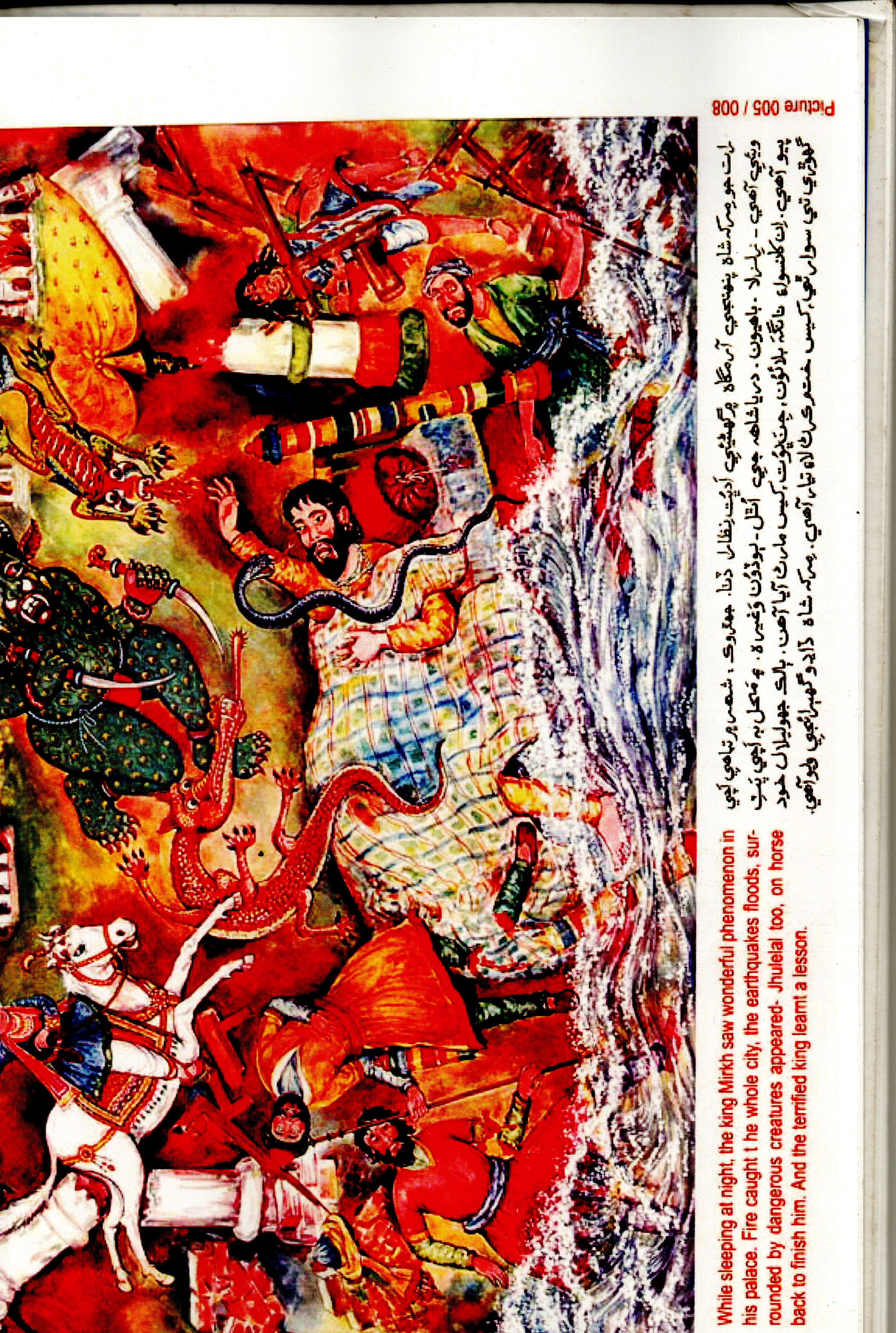
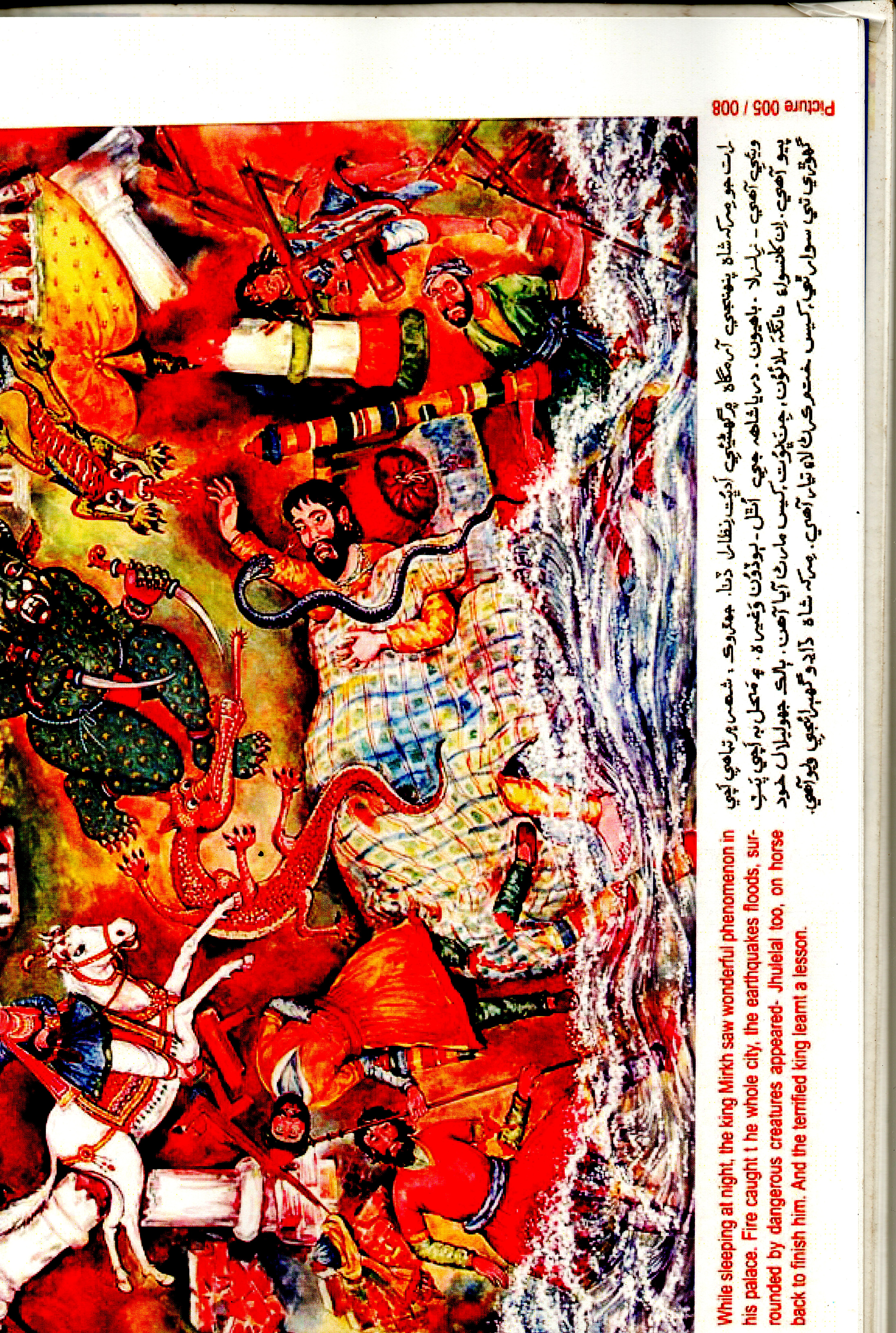
"King Mirkh's Lesson," also known by its Sindhi name "ميرک بادشاه جو سبق," recounts a pivotal legend in Sindhi heritage concerning the tyrannical King Mirkhshah and the divine intervention of Jhulelal, the patron deity of Sindhi Hindus. The narrative describes a period in the 10th century CE when King Mirkhshah, a ruler in Thatta, Sindh, issued an ultimatum to the local Hindu population: convert to Islam or face death. In their desperation, the Sindhi Hindus prayed to Varuna, the Vedic god of water, for forty days. Their prayers were answered with the birth of Jhulelal, an incarnation of Varuna, in Nasarpur. Jhulelal, exhibiting divine powers from childhood, confronted the king. Through a series of miraculous demonstrations and compelling arguments for religious tolerance and unity, Jhulelal convinced Mirkhshah to abandon his oppressive decree and grant religious freedom to the Sindhi people. This legend symbolizes Jhulelal's role as a protector of the Sindhi people and their faith against oppression, and it underscores the values of peace, harmony, and religious coexistence.
Historical Overview
The legend of King Mirkh's Lesson is deeply rooted in the history and folklore of the Sindhi people, particularly Sindhi Hindus. It dates back to the 10th century CE, specifically around 1007 Vikram Samvat (equivalent to 950 CE). At this time, Sindh was under the rule of the tyrannical Islamic ruler Mirkhshah (also referred to as Mirikhshah or Mirkshah), whose seat of power was in Thatta. Faced with Mirkhshah's decree to forcibly convert to Islam or face execution, the distressed Sindhi Hindus turned to prayer, appealing to Varuna, the god of water, on the banks of the Indus River for forty days, a period known as 'Chaliho'.
According to the legend, their fervent prayers were answered when Varuna promised to incarnate to save them. This divine promise materialized with the birth of Uderolal, who later became known as Jhulelal, to Devaki and Ratanchand Lohano in Nasarpur. From a very young age, Jhulelal displayed extraordinary, divine powers. He confronted King Mirkhshah, advocating for religious freedom and preaching a message of unity and tolerance, emphasizing that both Hindus and Muslims worship the same God. Initially, Mirkhshah scorned Jhulelal and attempted to imprison him; however, after witnessing numerous miracles and Jhulelal's ability to control the elements, the king became fearful and was ultimately convinced to cease his persecution. He granted religious freedom to the Hindu population. This pivotal event established Jhulelal as the savior and protector of the Sindhi community and their faith.
Cultural Significance
The legend of King Mirkh's Lesson holds profound cultural significance for Sindhis worldwide. Jhulelal is revered as the 'Ishta Dev' (patron deity) and the main community God for Sindhi Hindus. His story is a cornerstone of Sindhi identity and faith, embodying values of protection, justice, and unwavering belief. He represents unity amidst diversity, courage in the face of tyranny, harmony with the natural world (especially water), and deep devotion to truth and dharma.
Jhulelal's teachings underscore the importance of peace, harmony, and religious tolerance, resonating deeply within the Sindhi community. His birthday, known as Cheti Chand, is one of the most significant festivals for Sindhis, celebrated with immense joy, vibrant processions, and cultural festivities globally. The narrative of Jhulelal's triumph over oppression serves as a continuous source of inspiration for Sindhis, encouraging them to remain strong and proud of their rich history and cultural heritage. Furthermore, Jhulelal is uniquely revered by both Sindhi Hindus and Sufi Muslims, symbolizing a bridge between faiths and a shared heritage of communal harmony in Sindh.
"This heritage place preserves the spirit of cultural memory, where architecture, landscape, and history come together in one experience."
— Cultural Heritage Board DocumentationVisual Journey