Lord Jhulelal
Lord Jhulelal holds profound cultural and spiritual significance for Sindhis globally, serving as the central icon of their faith, devotion, and cultural identity. He is revered as the 'Ishta Dev' or community deity of Sindhi Hindus and is considered an incarnation of Lord Varuna, the god of water. His teachings emphasize peace, harmony, tolerance, and the fundamental unity of humanity, making him an emblem of religious coexistence not just for Sindhis but for all.
His life and message are a constant source of inspiration, encouraging Sindhis to uphold truth, service, and unity. The annual celebration of Cheti Chand, Jhulelal's birthday, is one of the most significant festivals for Sindhis, marked by fervent prayers, devotional songs (bhajans), and processions known as 'Baharana Sahib,' where offerings are made to the water god. This festival reinforces Sindhi identity and cultural values.
A unique aspect of his cultural significance is his reverence by both Hindus and Muslims in Sindh. While Hindus worship him as Jhulelal, Muslims refer to him as Khwaja Khizr or Zindah Pir (the Living Saint). This shared reverence is particularly evident at the Shrine at Odero Lal, which is jointly used by both communities, symbolizing a long history of interfaith harmony and a shared heritage along the Indus River. His legacy continues to be a unifying force, preserving the spiritual, artistic, and linguistic cultures of the Sindhi community worldwide.
Lord Jhulelal
ڀڳوان جھوليلال
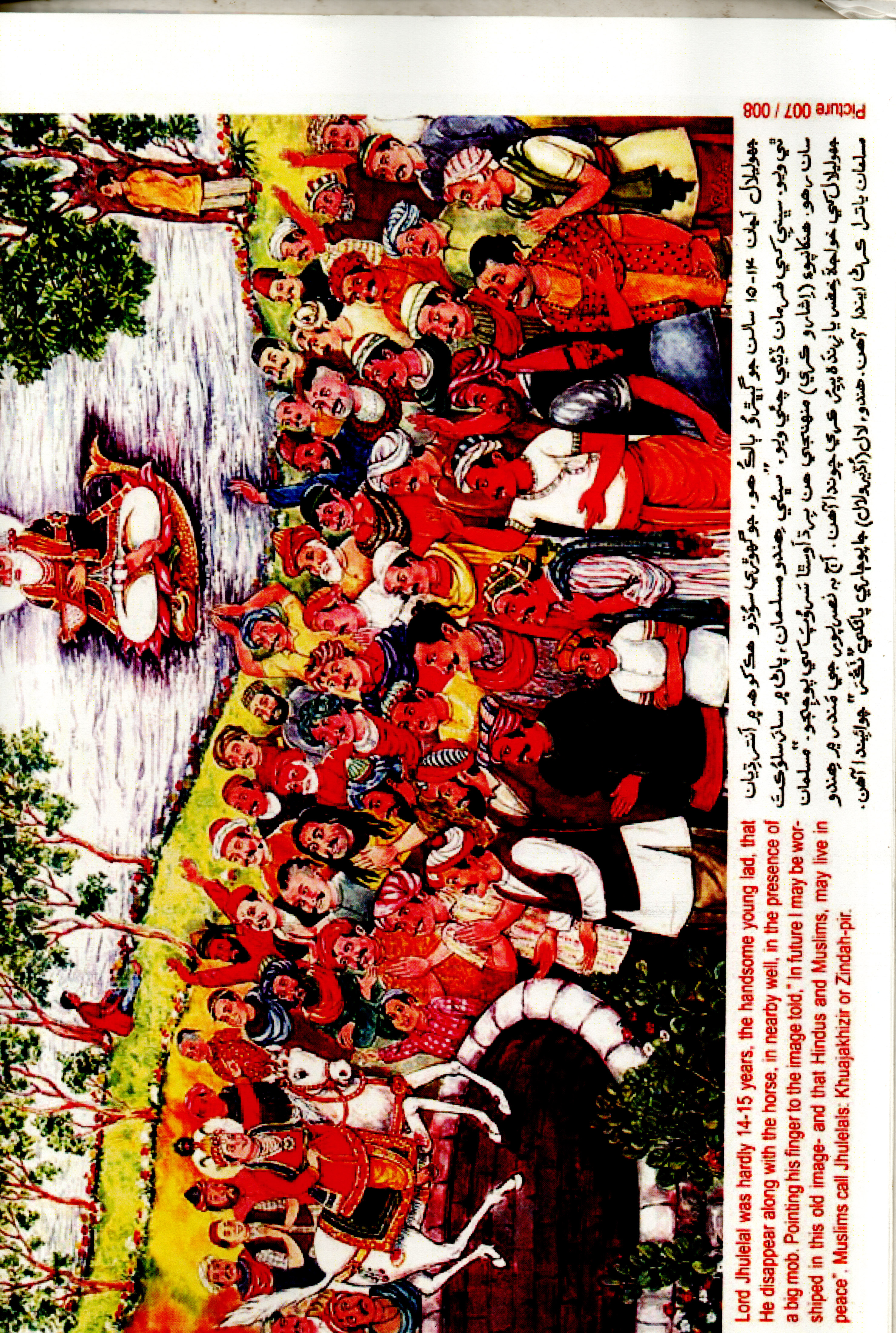
Lord Jhulelal, also known by names such as Uderolal, Daryalal, Amarlal, Lal Sai, Khwaja Khizr, and Zindah Pir, is a revered figure in Sindhi heritage, embodying unity and religious harmony. He is primarily worshipped by Sindhi Hindus as an incarnation of Lord Varuna, the Hindu god of water. According to tradition, he appeared as a handsome young lad, often depicted around 14-15 years old, to protect the Sindhi community from religious persecution.
His legend describes him disappearing with his horse amidst a large crowd, with the belief that he will reappear in a grander form in the future. An accompanying image often portrays him pointing to a crowd, symbolizing the peaceful coexistence he fostered between Hindus and Muslims. Sindhi Muslims deeply revere him as Khwaja Khizr or Zindah Pir, highlighting his significance across different faiths in Sindhi culture. He is considered the patron saint and community deity (Ishta Dev) of the Sindhi people worldwide.
Historical Overview
The historical narrative of Lord Jhulelal dates back to approximately the 10th century (specifically, 1007 Vikram Samvat, or 950 CE), during a period when the Sindh region faced oppression under a tyrannical ruler named Mirkhshah of Thatta. Mirkhshah issued an ultimatum, ordering local Hindus to convert to Islam or face death. In response, the terrified Sindhi Hindus prayed fervently to Lord Varuna on the banks of the Indus River for forty days, seeking divine intervention.
Pleased by their devotion, Lord Varuna promised to incarnate himself to save them. Consequently, Jhulelal was born in Nasarpur to Ratnarayan (also known as Rattanchand Lohano) and Devaki. From childhood, he displayed supernatural powers and divine qualities, earning him names like Uderolal, meaning 'one who has sprung from the waters'.
Jhulelal grew to be a wise and brave leader, teaching principles of peace, fairness, religious freedom, and the unity of God. He confronted Mirkhshah, explaining that both Muslims and Hindus worship the same God and emphasizing that forced conversion was forbidden. Mirkhshah, impressed and swayed by Jhulelal's teachings and miraculous displays (including a sudden inferno and flood), relented and revoked his decree, ceasing the persecution of Hindus. This event solidified Jhulelal's place as a protector of religious harmony and a symbol of hope for the Sindhi community.
Cultural Significance
Lord Jhulelal holds profound cultural and spiritual significance for Sindhis globally, serving as the central icon of their faith, devotion, and cultural identity. He is revered as the 'Ishta Dev' or community deity of Sindhi Hindus and is considered an incarnation of Lord Varuna, the god of water. His teachings emphasize peace, harmony, tolerance, and the fundamental unity of humanity, making him an emblem of religious coexistence not just for Sindhis but for all.
His life and message are a constant source of inspiration, encouraging Sindhis to uphold truth, service, and unity. The annual celebration of Cheti Chand, Jhulelal's birthday, is one of the most significant festivals for Sindhis, marked by fervent prayers, devotional songs (bhajans), and processions known as 'Baharana Sahib,' where offerings are made to the water god. This festival reinforces Sindhi identity and cultural values.
A unique aspect of his cultural significance is his reverence by both Hindus and Muslims in Sindh. While Hindus worship him as Jhulelal, Muslims refer to him as Khwaja Khizr or Zindah Pir (the Living Saint). This shared reverence is particularly evident at the Shrine at Odero Lal, which is jointly used by both communities, symbolizing a long history of interfaith harmony and a shared heritage along the Indus River. His legacy continues to be a unifying force, preserving the spiritual, artistic, and linguistic cultures of the Sindhi community worldwide.
"This heritage place preserves the spirit of cultural memory, where architecture, landscape, and history come together in one experience."
— Cultural Heritage Board DocumentationVisual Journey