Birth of Jhulelal and Vazir Ahyo's Encounter
Jhulelal holds profound cultural and spiritual significance for Sindhis worldwide, serving as their 'Ishta Deva' or chosen community deity. He symbolizes the essence of Sindhi cultural identity, instilling a sense of belonging, resilience, and pride among the community. The narrative of his birth and triumph over tyranny embodies themes of unwavering faith, unity, justice, and the ultimate victory of good over evil, which deeply resonate with Sindhis.
The festival of Cheti Chand, celebrating Jhulelal's birthday, is the most vital annual observance for Sindhi Hindus. It is celebrated with great fervor through special prayers, devotional songs (bhajans), and colorful processions known as 'Baharana Sahib,' where offerings are made to the water god Varuna, typically at a river or lake. Beyond religious festivities, Jhulelal's teachings promote universal values of peace, harmony, religious tolerance, and brotherhood, influencing interfaith understanding in multicultural societies. His association with water, particularly the Indus River, links him to the Sindhi people's historical and geographical roots, as he is also considered the protector of sailors and travelers. This unique blend of Vedic, folk, and Sufi elements in his worship has also led to his reverence by some Muslims as Zinda Pir, further highlighting his role as a unifying bridge between faiths in Sindh.
Birth of Jhulelal and Vazir Ahyo's Encounter
جھوليلال جي پيدائش ۽ وزير آهيو جو مقابلو
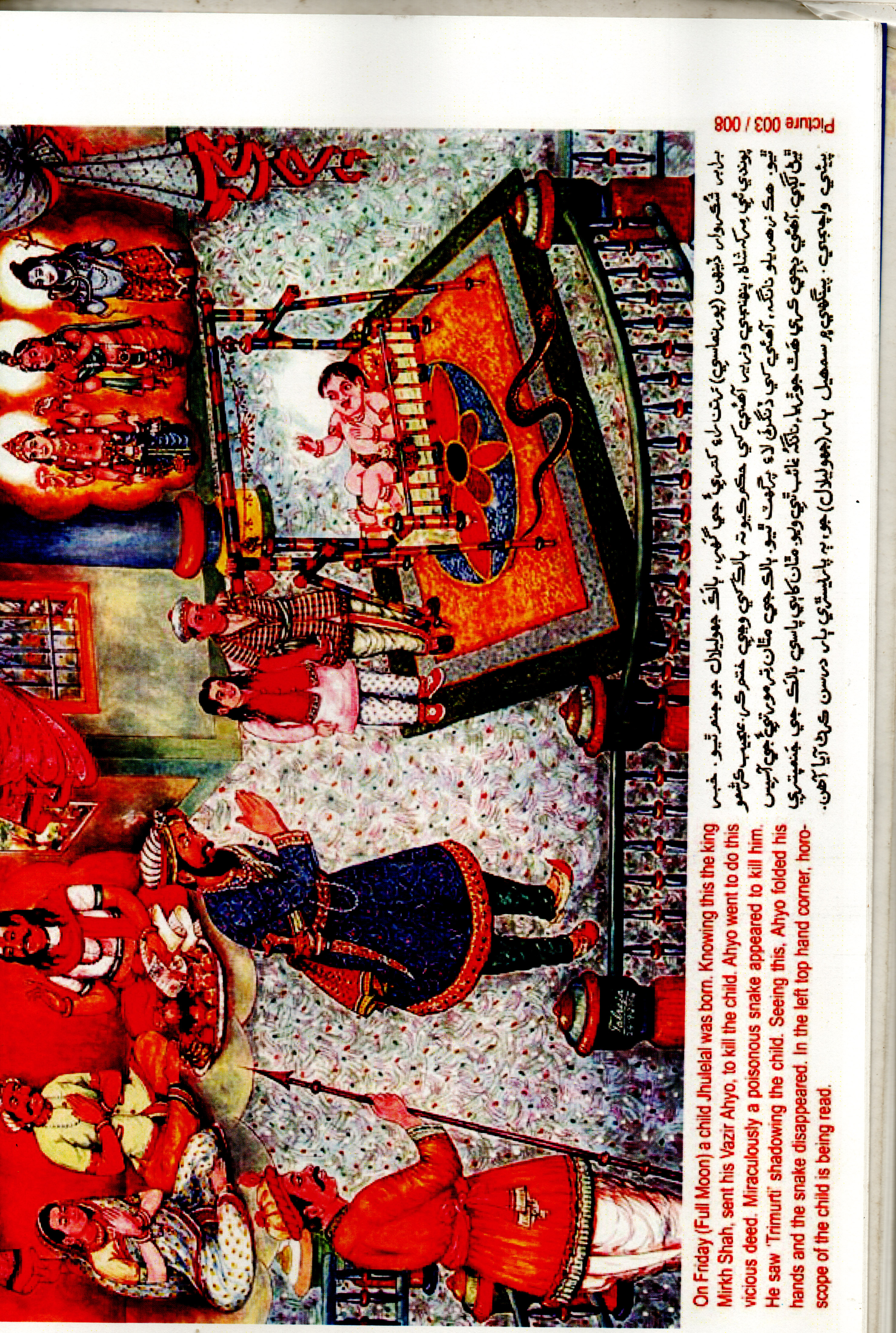
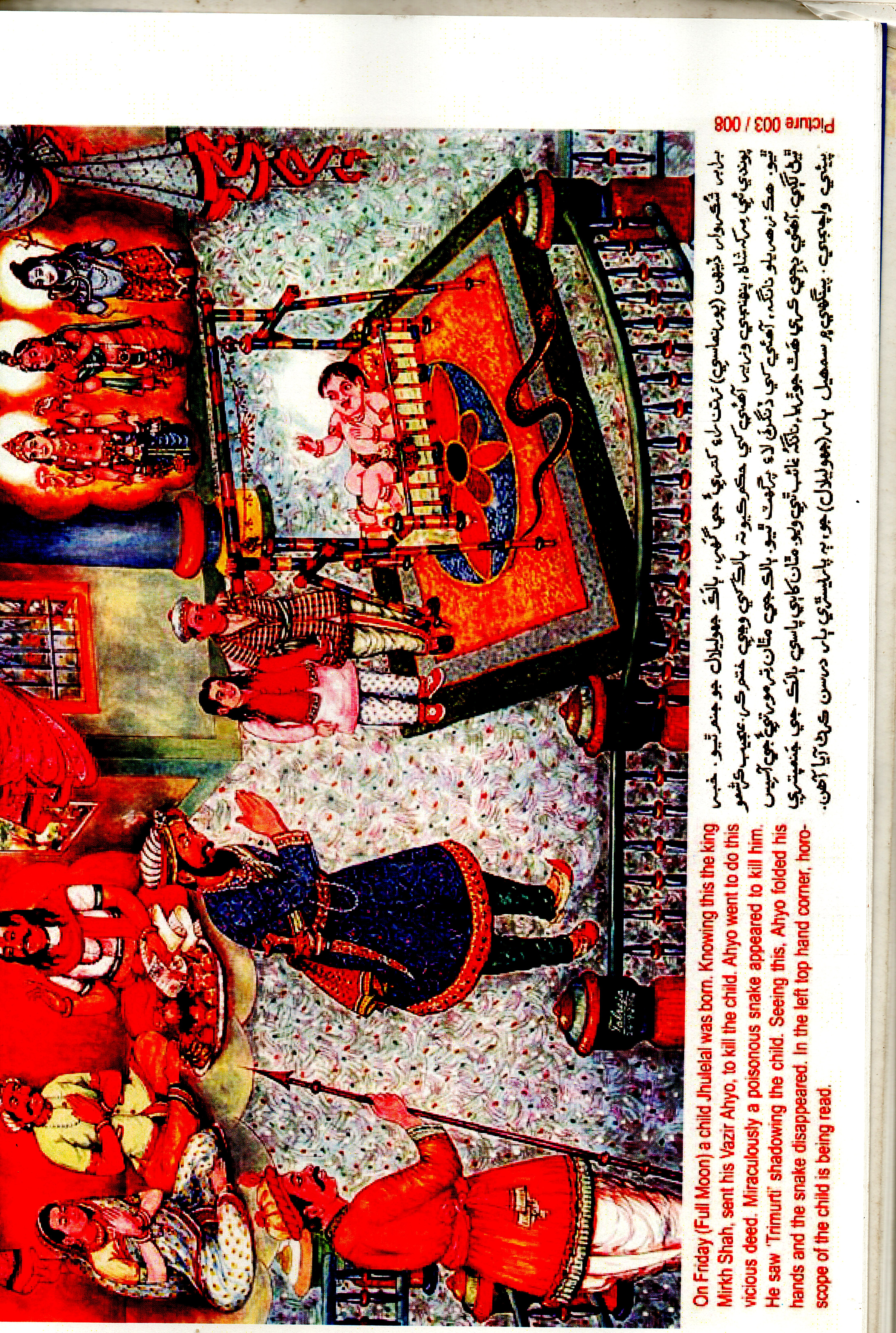
The narrative of the Birth of Jhulelal and Vazir Ahyo's Encounter recounts the miraculous appearance of Jhulelal, the revered deity of Sindhi Hindus, during a period of religious persecution. According to legend, the birth of Jhulelal occurred on Cheti Chand, the second day of the Hindu month of Chaitra, which also marks the Sindhi New Year. During this era, a tyrannical ruler named Mirkh Shah in Thatta, Sindh, threatened local Hindus with forced conversion to Islam. After 40 days of fervent prayers to Lord Varuna, the god of water, a divine voice promised a savior would be born. Jhulelal was born to Devaki and Ratanchand Lohano in Nasarpur. Upon his birth, the infant Jhulelal displayed extraordinary powers; when he opened his mouth, the mighty Indus River flowed forth, with an old man seated on a pala fish within. His cradle also swung on its own, earning him the name 'Jhulelal' (Lord of the Swing).
King Mirkh Shah, skeptical of the prophecies, sent his minister, Ahirio (also known as Ahyo), to ascertain the truth and eliminate the child. Ahirio approached the infant with a poisoned rose, but Jhulelal miraculously blew the rose away and transformed before the minister's eyes. The child successively manifested as an old man with a long beard, a young lad, and then a warrior on horseback, surrounded by an army, representing the Trimurti and divine protection. Overwhelmed by these divine manifestations, Ahirio abandoned his mission, begged for forgiveness, and became a devotee of Jhulelal. He returned to Mirkh Shah to relay the astonishing encounter, but the king remained unconvinced, eventually leading to Jhulelal confronting him and convincing him to halt the persecution and embrace religious tolerance.
Historical Overview
Jhulelal is a prominent folkloric figure and one of the most revered deities among Sindhi Hindus in both Pakistan and India, largely considered an avatar of the Hindu god Varuna, the deity of water. The legend of Jhulelal is set in the 10th century CE, specifically around 1007 Vikram Samvat (950 CE), in the historical region of Sindh. This period was marked by the rule of King Mirkh Shah (also identified as Mirkshah or Makrab Khan), a tyrannical Muslim ruler of Thatta, who issued a decree for the local Hindu population to convert to Islam or face execution.
In response to this grave threat, the distressed Sindhi Hindus turned to the Indus River, praying fervently to Lord Varuna for 40 days, a ritual period known as 'Chalioh' or 'Chaliho Sahib'. Their prayers were answered with a divine prophecy that Varuna would soon incarnate to save them. True to the prophecy, Jhulelal was born to Mata Devaki and Ratanchand Lohano in Nasarpur on the auspicious day of Cheti Chand. The infant, also known as Udaichand and Uderolal, exhibited supernatural powers from birth, including the manifestation of the Indus River and an old man on a pala fish in his mouth, and his cradle swinging independently, leading to the name 'Jhulelal'.
King Mirkh Shah, upon hearing of the divine child, sent his minister Ahirio to investigate and eliminate the perceived threat. Ahirio's attempt to poison the infant was thwarted by Jhulelal's miraculous transformations into various divine forms, leading the minister to abandon his mission and become a devotee. Ultimately, Jhulelal confronted Mirkh Shah, teaching him about the unity of God and the importance of religious freedom, thereby convincing the ruler to cease the forced conversions and ensuring peace between the communities.
Cultural Significance
Jhulelal holds profound cultural and spiritual significance for Sindhis worldwide, serving as their 'Ishta Deva' or chosen community deity. He symbolizes the essence of Sindhi cultural identity, instilling a sense of belonging, resilience, and pride among the community. The narrative of his birth and triumph over tyranny embodies themes of unwavering faith, unity, justice, and the ultimate victory of good over evil, which deeply resonate with Sindhis.
The festival of Cheti Chand, celebrating Jhulelal's birthday, is the most vital annual observance for Sindhi Hindus. It is celebrated with great fervor through special prayers, devotional songs (bhajans), and colorful processions known as 'Baharana Sahib,' where offerings are made to the water god Varuna, typically at a river or lake. Beyond religious festivities, Jhulelal's teachings promote universal values of peace, harmony, religious tolerance, and brotherhood, influencing interfaith understanding in multicultural societies. His association with water, particularly the Indus River, links him to the Sindhi people's historical and geographical roots, as he is also considered the protector of sailors and travelers. This unique blend of Vedic, folk, and Sufi elements in his worship has also led to his reverence by some Muslims as Zinda Pir, further highlighting his role as a unifying bridge between faiths in Sindh.
"This heritage place preserves the spirit of cultural memory, where architecture, landscape, and history come together in one experience."
— Cultural Heritage Board DocumentationVisual Journey