The Story of Mirkh Shah and Jhulelal
Jhulelal holds immense cultural and spiritual significance for Sindhis worldwide, serving as their Ishta Deva (chosen deity) and a central symbol of faith, devotion, and cultural identity. He is revered as an incarnation of Lord Varuna, the god of water, and sometimes associated with Lord Krishna or Vishnu. Jhulelal's story is a powerful narrative of courage in the face of oppression, representing the protection of religious freedom and the triumph of good over evil. For the Sindhi community, he embodies their cultural heritage, providing a sense of belonging and pride, especially after the displacement during the Partition of India. His teachings promoting love, peace, tolerance, and human unity transcend communal boundaries, fostering understanding among diverse communities. Before every auspicious occasion, Jhulelal is remembered, and his bhajans, aartis, and pujas are performed with special devotion in Sindhi families. The festival of Cheti Chand, marking his birth anniversary, is the most important celebration for Sindhi Hindus, emphasizing unity, faith, and cultural traditions. Additionally, Jhulelal is seen as the protector of sailors and travelers, particularly by those in trade.
The Story of Mirkh Shah and Jhulelal
میرک شاهه ۽ جھوليلال جي ڪهاڻي
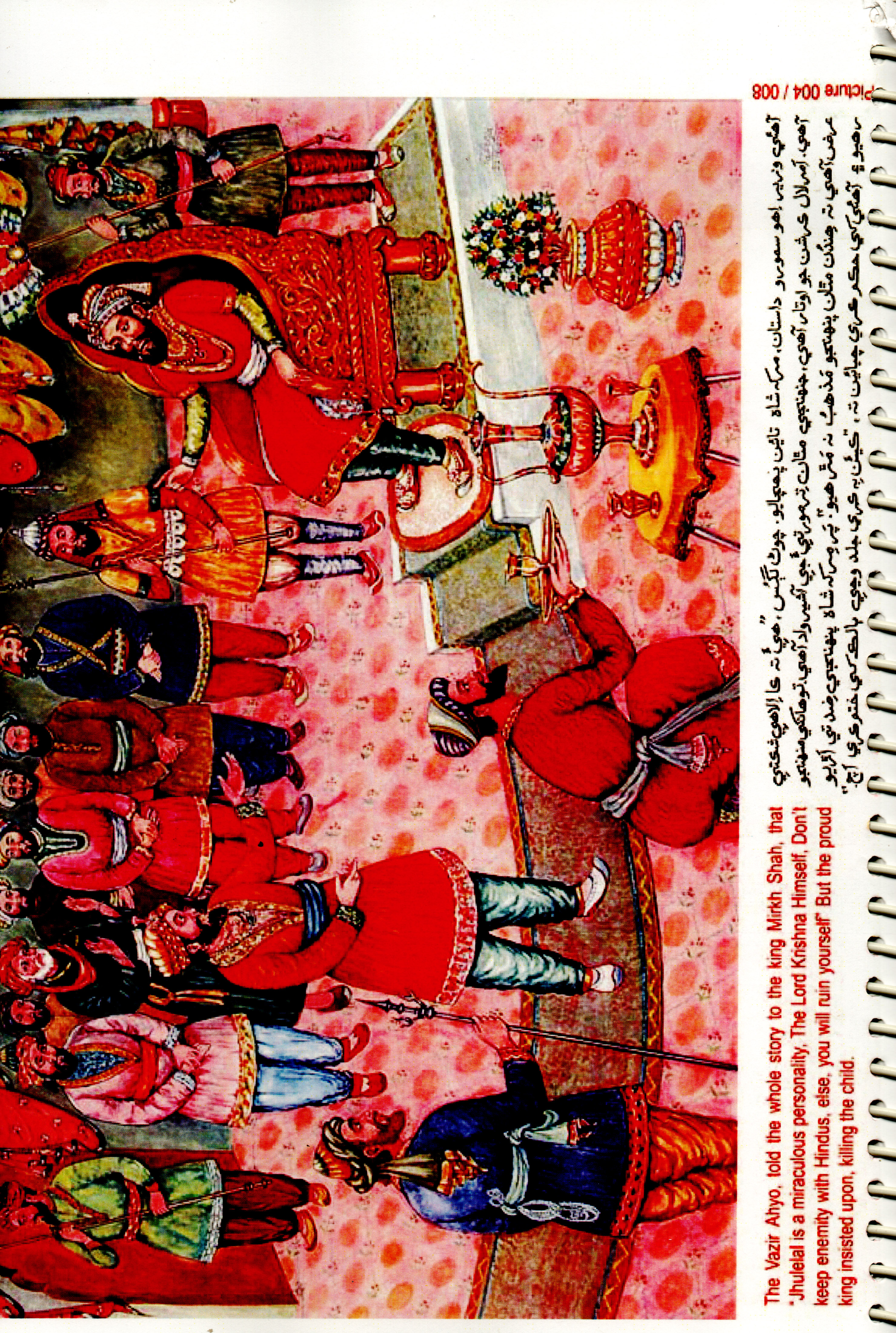
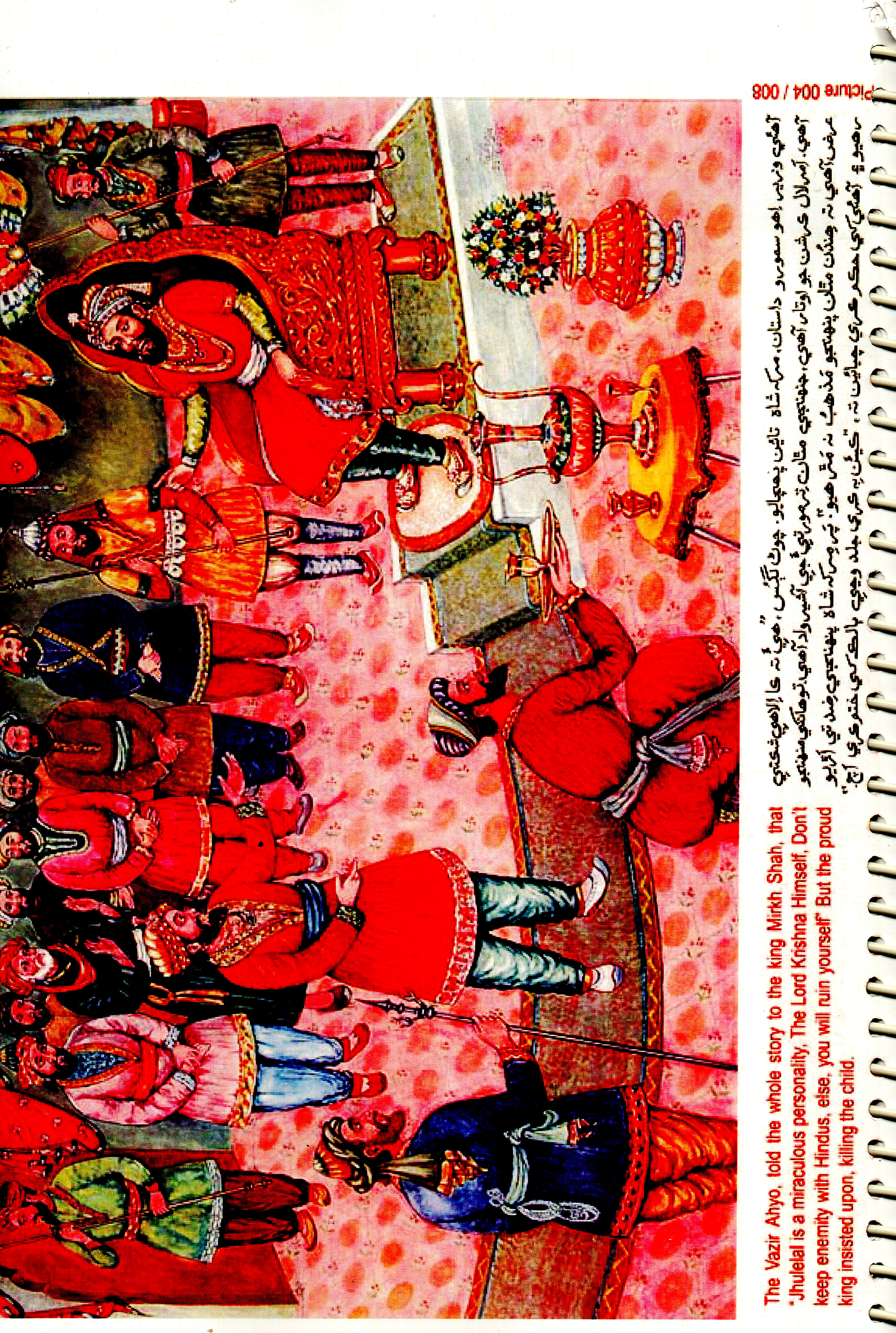
The story of Mirkh Shah and Jhulelal recounts a pivotal moment in Sindhi heritage, highlighting the divine intervention of Jhulelal, a revered figure in Sindhi culture. During the 10th century, the tyrannical ruler Mirkh Shah of Thatta in Sindh issued a decree threatening local Hindus with forced conversion to Islam. In their distress, the Sindhi Hindus prayed to Lord Varuna, the god of water, for forty days. Their prayers were answered with the divine manifestation of Jhulelal, who was born as Uderolal in Nasarpur. Vazir Ahyo, one of King Mirkh Shah's advisors, cautioned the king against persecuting Hindus and revealed Jhulelal's divine nature as an incarnation of Lord Varuna (sometimes associated with Lord Krishna or Vishnu). The Vazir warned the king that his continued enmity would lead to his own destruction. However, the arrogant King Mirkh Shah remained steadfast in his tyrannical decision to harm the child, Jhulelal, setting the stage for legendary events where Jhulelal demonstrated his miraculous powers, including causing floods and fires to engulf the king's palace. Ultimately, Jhulelal convinced Mirkh Shah to cease his persecution and respect religious freedom, earning devotees among both Hindus and Muslims.
Historical Overview
The historical narrative of Jhulelal originates around the 10th century CE, during a period when Sindh was under the rule of Muslim leaders. According to popular belief, a despotic ruler named Mirkh Shah in Thatta (or sometimes associated with the Soomra dynasty) initiated a campaign to forcibly convert Hindus to Islam. Faced with this oppression, the Sindhi Hindu community observed a forty-day period of fasting and prayer to the River God Varuna, seeking deliverance. As a result of these fervent prayers, Lord Varuna incarnated as a child named Uderolal, born to Ratnarayan (or Rattan Rai) and Devaki in Nasarpur on the auspicious day of Cheti Chand, which is the second day of the Chaitra month in the Hindu lunar calendar, around 1007 Vikram Samvat (approximately 950 CE). From his infancy, Jhulelal exhibited miraculous powers. When King Mirkh Shah's advisor, Ahirio (or Vazir Ahyo), was sent to investigate, Jhulelal appeared in various forms, including an old man, and warned the king against religious discrimination. The legend describes how, when Mirkh Shah tried to arrest him, Jhulelal caused floods and fires, demonstrating his divine power and conveying the message that God is one, regardless of how He is worshipped. Mirkh Shah, witnessing these miracles, eventually relented, revoked his decree, and embraced the message of religious harmony. Jhulelal's teachings emphasized peace, tolerance, and unity. The Shrine at Odero Lal in Sindh, Pakistan, is a significant site associated with Jhulelal, jointly used by Hindus and Muslims, and was completed around 1684 C.E.
Cultural Significance
Jhulelal holds immense cultural and spiritual significance for Sindhis worldwide, serving as their Ishta Deva (chosen deity) and a central symbol of faith, devotion, and cultural identity. He is revered as an incarnation of Lord Varuna, the god of water, and sometimes associated with Lord Krishna or Vishnu. Jhulelal's story is a powerful narrative of courage in the face of oppression, representing the protection of religious freedom and the triumph of good over evil. For the Sindhi community, he embodies their cultural heritage, providing a sense of belonging and pride, especially after the displacement during the Partition of India. His teachings promoting love, peace, tolerance, and human unity transcend communal boundaries, fostering understanding among diverse communities. Before every auspicious occasion, Jhulelal is remembered, and his bhajans, aartis, and pujas are performed with special devotion in Sindhi families. The festival of Cheti Chand, marking his birth anniversary, is the most important celebration for Sindhi Hindus, emphasizing unity, faith, and cultural traditions. Additionally, Jhulelal is seen as the protector of sailors and travelers, particularly by those in trade.
"This heritage place preserves the spirit of cultural memory, where architecture, landscape, and history come together in one experience."
— Cultural Heritage Board DocumentationVisual Journey