King Mirkh's Repentance and Promise of Equality
The legend of King Mirkh's repentance and Lord Jhulelal's intervention holds profound cultural significance for Sindhis worldwide. Lord Jhulelal is revered as the patron saint and savior of Sindhi Hindus, symbolizing courage, righteousness, and divine protection against injustice.
This narrative is a testament to the historical tradition of religious tolerance and interfaith harmony that has long been a hallmark of Sindhi culture. It highlights the belief in a singular divine essence that transcends religious boundaries, promoting the idea that both Hindus and Muslims are equally cherished creations of the same God.
The annual Cheti Chand festival, celebrating Jhulelal's birth, serves as a vibrant cultural observance that reinforces these values among the Sindhi community. After the partition of India, Jhulelal became an even more significant unifying icon for the displaced Sindhi community, helping them to preserve their spiritual and cultural identity. The story continues to inspire mutual respect and peaceful coexistence, demonstrating Sindh's deep-rooted commitment to diversity and inclusion.
King Mirkh's Repentance and Promise of Equality
ميرک بادشاهه جي توبه ۽ برابري جو اقرار
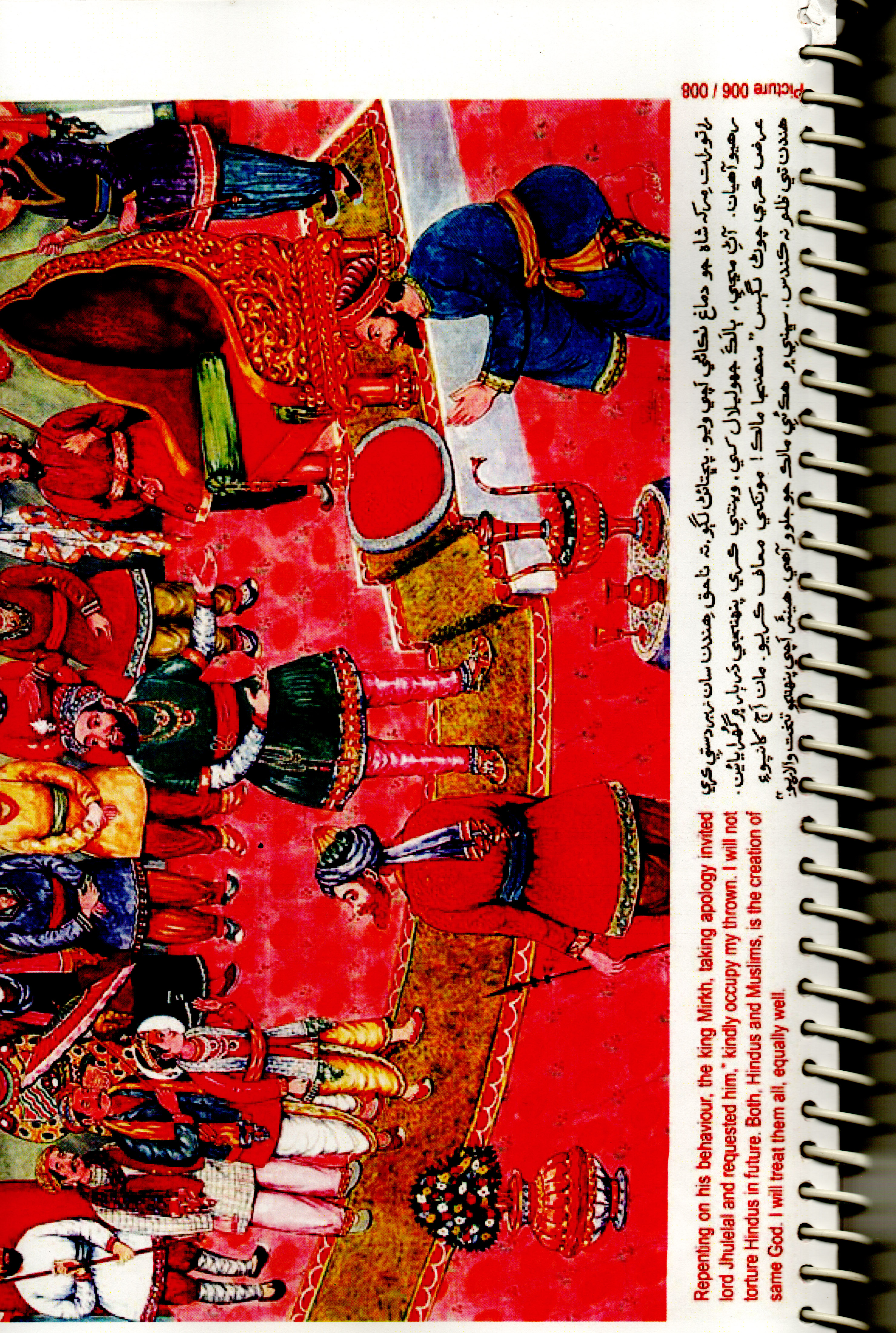
The narrative of King Mirkh's Repentance and Promise of Equality is a cornerstone of Sindhi heritage, illustrating a pivotal moment of religious tolerance and harmony. It recounts the story of King Mirkh (also known as Mirkshah or Mirikhshah), a ruler of Thatta in Sindh, who initially persecuted Hindus, demanding their conversion to Islam. In response to this tyranny, the Hindu community prayed to Lord Varuna, the water deity, who then incarnated as Uderolal, widely revered as Lord Jhulelal. Exhibiting divine powers from a young age, Jhulelal confronted King Mirkh, advocating for unity and equality between Hindus and Muslims, emphasizing their shared belief in one God. When the King attempted to suppress Jhulelal, his palace was afflicted by divine manifestations of fire and flood. This miraculous event led King Mirkh to realize his error, prompting his sincere repentance and a solemn promise to treat all his subjects with fairness, ensuring their religious freedom and the protection of their places of worship.
Historical Overview
In the early 11th century (some sources suggest the 10th century), Sindh was ruled by King Mirkh, a monarch from Thatta who initiated a decree demanding the conversion of local Hindus to Islam. Faced with this oppression, the Hindu populace turned to prayer, invoking Lord Varuna, the Hindu God of water, for forty consecutive days.
Their prayers were answered with the incarnation of Uderolal, known as Lord Jhulelal, who was born in 1007 Vikram Samvat (approximately 950 CE) in Nasarpur to Ratan Lal and Devaki. From his childhood, Jhulelal displayed miraculous powers and became a symbol of divine intervention against tyranny. He preached a message of unity, love, and harmony, asserting that both Muslims and Hindus were creations of the same God and deserved equal religious freedoms.
Initially, King Mirkh sought to arrest and eliminate Uderolal. However, during their confrontation, the King's palace was miraculously engulfed by an inferno and simultaneously flooded. Overwhelmed by these divine manifestations, Mirkhshah acknowledged his errors, repented for his past ill-treatment of Hindus, and sought forgiveness from Jhulelal. The King then pledged to ensure equality for all his subjects and to protect Hindu places of worship, thereby fostering an environment of religious tolerance. This event led to King Mirkh and other Muslims becoming devotees of Jhulelal, solidifying a legacy of interfaith coexistence in Sindh.
Cultural Significance
The legend of King Mirkh's repentance and Lord Jhulelal's intervention holds profound cultural significance for Sindhis worldwide. Lord Jhulelal is revered as the patron saint and savior of Sindhi Hindus, symbolizing courage, righteousness, and divine protection against injustice.
This narrative is a testament to the historical tradition of religious tolerance and interfaith harmony that has long been a hallmark of Sindhi culture. It highlights the belief in a singular divine essence that transcends religious boundaries, promoting the idea that both Hindus and Muslims are equally cherished creations of the same God.
The annual Cheti Chand festival, celebrating Jhulelal's birth, serves as a vibrant cultural observance that reinforces these values among the Sindhi community. After the partition of India, Jhulelal became an even more significant unifying icon for the displaced Sindhi community, helping them to preserve their spiritual and cultural identity. The story continues to inspire mutual respect and peaceful coexistence, demonstrating Sindh's deep-rooted commitment to diversity and inclusion.
"This heritage place preserves the spirit of cultural memory, where architecture, landscape, and history come together in one experience."
— Cultural Heritage Board DocumentationVisual Journey